Is San Diego Comic-Con Worth It? I Flew Out From New York to Find Out
What nearly 20 years of NYCC didn't prepare me for, and the one question that decides your whole trip
If you're reading this, you're probably where I was a few months ago: a con-goer somewhere else in the country, wondering whether San Diego Comic-Con deserves the flights, the hotel prices, and the mythology. I've been going to New York Comic Con since 2008, all four days every year for the better part of the last decade, so the Javits is my home building. This July I finally made the pilgrimage west to answer the question for myself.
The answer, up front: SDCC is worth it under exactly one condition, and that condition is Hall H. If you can realistically get into that room, go once in your life. If you can't, nearly everything San Diego offers exists in a bigger version in New York, and I can save you the airfare. The rest of this piece is me earning that verdict, including the 36-hour system you'd have to survive, which nobody at SDCC will explain to you before you land. This year, that system broke in ways that made the news, and I was standing in the middle of it.
The part nobody tells you: the line is a job
Everything mythological about SDCC lives in one room. Hall H seats about 6,100 people and hosts the things you cannot see anywhere else: Marvel Studios, the film tentpoles, the A-list casts. Because everyone knows it, admission has evolved into something between a campout and a shift job, and if you're considering this trip, you need to understand it in detail before you book anything.
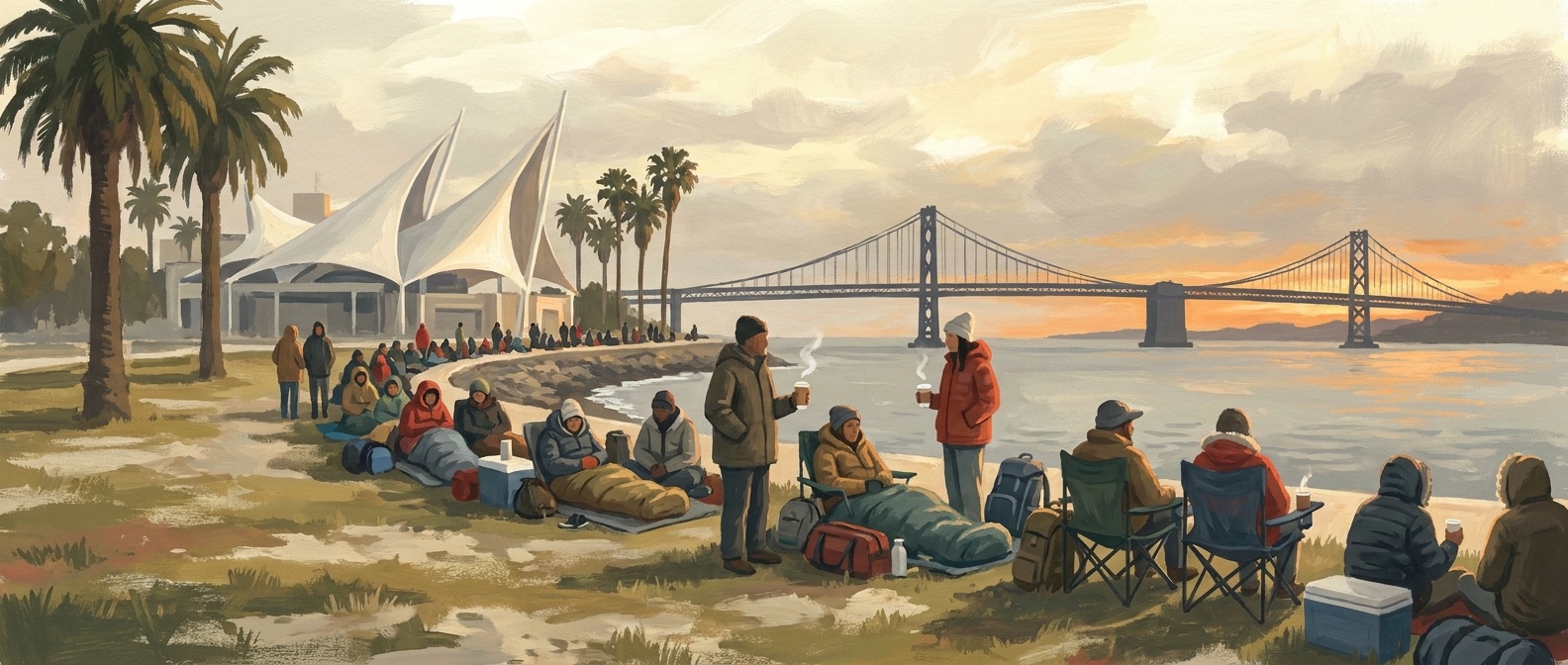
Here's how it's supposed to work. The line for Saturday's panels, what SDCC calls the Next Day Line, starts forming Thursday evening on a lawn behind the convention center. At some random, unannounced point, staff walk the line handing out what I'd call counting wristbands to whoever is physically present. Each counting wristband lets one person claim official seating wristbands for themselves plus up to two others. The seating wristbands go out Friday evening, and those are the ones that actually promise you a seat. Late Friday night or early Saturday morning, seating wristband holders move up from the lawn into tented chutes on the plaza under the building's white sails, right beside Hall H's doors, and Saturday morning they walk in. Three stages, two kinds of wristbands, a day and a half of your life.
Since no human can hold a spot for 36 hours, people organize, and the organizing starts before you ever land. I posted in a Facebook group looking for anyone who could help a first-timer crack Hall H, and a fan who's been running this gauntlet with her friends for years reached out and offered me a spot in her group. Her crew came with a shared spreadsheet in a WhatsApp chat: names, phone numbers, shift blocks, seventy-plus people deep. Most of us were strangers to each other. There were veterans, a bunch of newbies like me, people from all over the country, though the majority were California residents. Thursday night crews start the line. Overnight crews hold it to 5 AM. Morning, midday, afternoon, and second-overnight crews carry it home, with the chat running constant headcount math off the one-holds-for-two rule: twenty-one people arriving between four and five means the group needs twenty-five to twenty-seven bodies physically present. Every shift opens with a group photo posted to the chat, serving as proof of attendance, a face reference for the next crew, and a location pin. Someone brings Krispy Kremes on the morning shift. Ours had a no-nuts rule, on account of group allergies.
You should also know where this happens, because I spent a night on Google Maps before my flight trying to find it and couldn't. The line isn't out front on Harbor Drive where all the photos are taken. It lives behind the building on the bay side, on Embarcadero Marina Park South, a grassy peninsula with a eucalyptus grove, a gazebo, and a straight view of the Coronado Bridge, roped into a route with orange posts and patrolled by staff in green shirts whose actual job title is Toucan Tracker. There's no badge scan out there, since it's public ground, and until con week it's just a park, invisible to any map.
I did the 5-to-9 AM Friday shift, plus extra covering for dropouts. And honestly? Out on that grass, passing donuts around with strangers I'd met through a spreadsheet, watching the marina light up, I had more fun than I did in most of the building. The effort and passion out there are real, and they're the best argument San Diego has.
Now the part that decides your trip
At 1:30 in the morning on Friday, out on the peninsula, SDCC handed out the counting wristbands.
Remember, there's no published schedule for that drop; the randomness is intentional, supposedly to keep people from gaming it. But nobody in our group, including the veterans who'd done this for years, expected it in the middle of the night. Between the surprise timing and a genuine miscalculation in our own shift planning, we had five people standing on that lawn at a moment when we needed at least twenty. Five counting wristbands, each good for three seats. The math for seventy people died right there, at 1:30 AM, on the grass.
What followed was damage control. By Friday midday, part of the crew had split off to start a second group at the back of the line, and over the day we managed to sneak more of our people into it. Between the original position and the end-of-line crew, maybe forty of our seventy got into Hall H. I'm sure I could have been one of them if I'd stuck with it. But when the seating wristbands ran out Friday evening and the remedy offered to us was rejoining at the back, a full restart after two days of coordinated camping, I was already down on the whole situation, and the drama just wasn't worth it to me. I called it quits. My message to the chat that night read, in full, so this was a shitshow, and I stand by the analysis.
I'll add one thing you won't find in the FAQ: the security out there was on a power trip, and at points it got kind of physical, which was crazy to me. NYCC security is genuinely nice, unless you try to record shit when you're not supposed to.
And none of this was a fluke. The wristband system melted down all weekend at SDCC 2026, to the point of national news coverage. On Saturday, hundreds of people holding official seating wristbands, the ones that are supposed to guarantee entry, were still shut out of the Marvel panel when the room hit capacity by late morning and never turned over. Two days of camping, the wristband on their wrist, and a closed door. So price this into your decision honestly. The 36-hour system is not a guarantee. It's a lottery you work a job to enter, and this year even the winners lost. The convention itself is in on the joke; Saturday at 5 PM, half an hour before Marvel, Room 23ABC hosted a panel titled "Dread the Hall H 2026: More (Fictional) Comic Convention Horror Stories."
What you get if you miss the room
The good news for anyone pricing out this trip: the convention outside Hall H requires almost none of that suffering, and parts of it are genuinely great.
Ballroom 20, upstairs at the north end, is the television counterpart: about 4,900 seats, same never-clears rule, but reachable same-day if you use the rule as a door. I sat down for Family Guy at 1:30, stayed through an Entertainment Weekly panel, and had a good seat when the Reacher cast came out at 3:30, having waited in nothing longer than a restroom line. The small rooms ask even less: walk in ten minutes early, leave whenever. That's where I found the sleeper hit of my weekend, a Friday panel of Hollywood location scouts in Room 9, where working pros explained how they find the streets and buildings that become the movies, playing to a half-empty room because it was scheduled against the arena acts.
The NYCC reality check
Here's what surprised me most, though, walking the exhibit floor with nearly twenty years of New York in my legs: the floor is smaller. Noticeably. I did two full laps to be sure, then checked the numbers. The Javits has about 840,000 square feet of exhibit space to San Diego's 525,000. SDCC feels enormous because 135,000 people share the smaller building. Artist Alley in New York is a district you plan your day around; in San Diego it's a section along one side of the main hall. Even the studio presence inside the building runs thinner. At NYCC, Marvel builds a red-carpet compound on the floor with activation space holding a hundred-plus people at a time, and I found nothing matching it in San Diego's hall.
The panel schedule follows the same shape. San Diego holds cards New York never sees: Marvel Studios above all, and this year an Image Comics founders reunion that put McFarlane, Kirkman, Liefeld, Silvestri, and Stephenson on one stage. But below that top shelf, the programming thins into niche actors and promo filler faster than you'd expect, while New York spreads bigger names across every room of the building all weekend, out in general circulation. The number of times I've ended up nearly face to face with Jensen Ackles at NYCC is honestly crazy, and nobody slept on a lawn for it.
San Diego has the higher ceiling. New York has the higher floor, and the floor is where you actually spend your weekend.
So: should you go?
Run my math on your own situation.
Go if you can realistically get into Hall H, meaning you have the vacation days and the constitution for the lawn, and ideally a crew to shift-share with. The room is real. Nothing at any other con touches a full Hall H, and even the lawn, with its donuts and group photos and bay views, is worth one strange night of your life. Make the pilgrimage once, eyes open about the odds.
Skip it if Hall H isn't realistic for you and you have access to NYCC or another major con. Without the room, you're flying across the country for a smaller floor, a thinner Artist Alley, a top-heavy panel schedule, and a lottery that failed even its winners this year, at San Diego hotel prices. Everything else SDCC does well, New York does at greater scale in October.
If I ever come back, it'll be as press, because then I'd be committed to the story instead of the experience. The lawn, the wristbands, the whole beautiful broken machine: that's a different trip when it's material instead of your vacation.
I'm looking into it.